
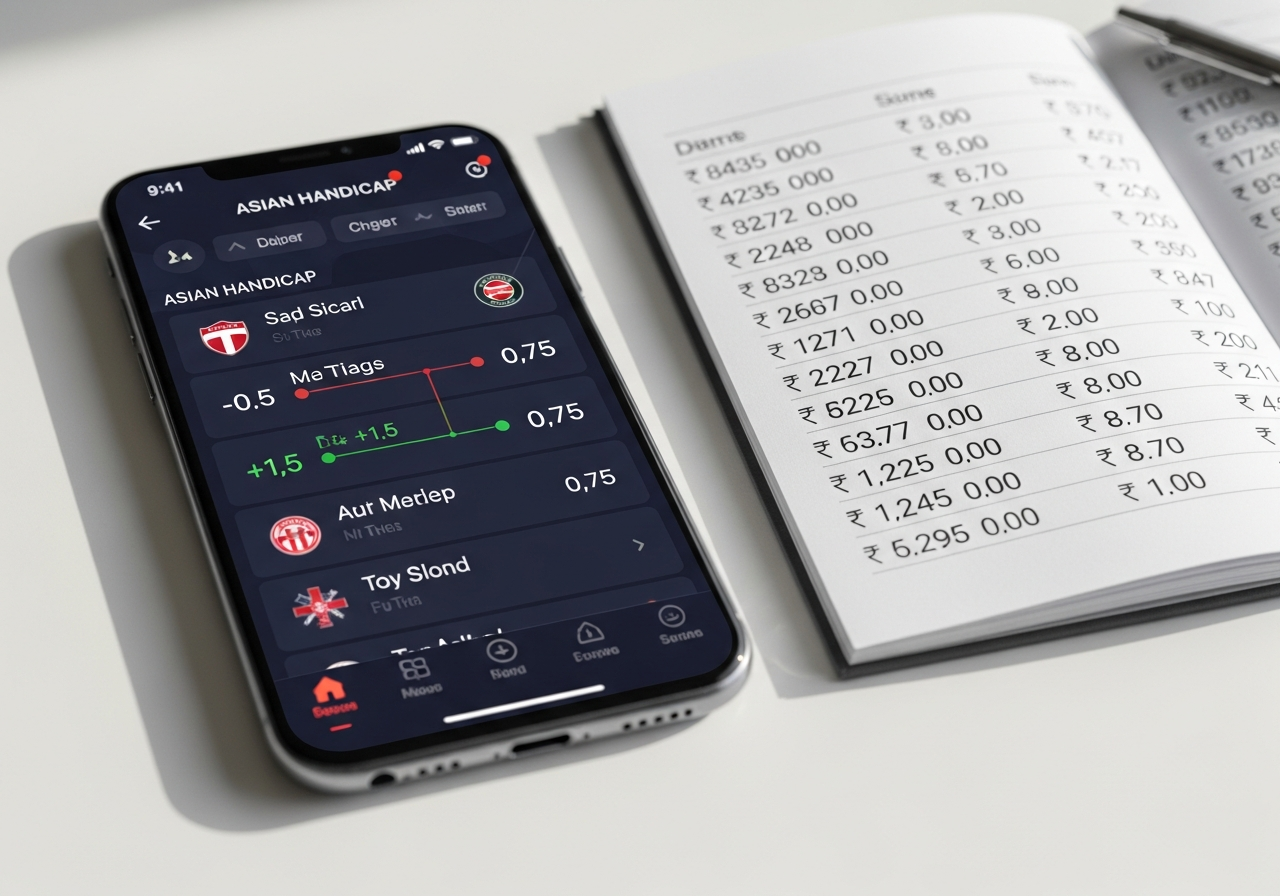
Asian handicap betting has become the go-to market for Indian football bettors seeking clearer value and higher returns. By removing the draw outcome and creating near 50-50 scenarios, Asian handicap markets offer a more straightforward path to profit compared to traditional three-way betting. Whether you’re wagering on the Indian Super League, I-League, or international tournaments, understanding how these handicap lines work can transform your betting strategy.
This comprehensive guide walks you through every type of Asian handicap line—from whole goals (0, -1, +1) to half-goals (-0.5, +1.5) and quarter-goals (0.25, 0.75, 1.25)—with practical rupee-based examples from ISL matches. We’ll compare Asian handicaps to traditional 1X2 markets, explain payout scenarios including half-wins and half-losses, and show you how to spot value in Indian football betting markets while managing your bankroll responsibly.
What Is Asian Handicap Betting and Why It Matters in India
Asian handicap betting is a form of football wagering that eliminates the draw by giving one team a virtual goal advantage or disadvantage before kick-off. This pre-adjustment levels the playing field between favourites and underdogs, creating odds much closer to evens (around 1.90–2.00) on both sides. Instead of choosing between home win, draw, or away win, you simply pick which team will cover the handicap.
For Indian bettors following the ISL, I-League, and European leagues, Asian handicaps offer distinct advantages over traditional 1X2 betting. The removal of the draw outcome means you have only two possibilities instead of three, instantly improving your theoretical win rate from 33% to 50%. This market structure is particularly valuable in matches with clear favourites—such as Mumbai City FC versus a mid-table ISL side—where 1X2 odds on the favourite may be prohibitively low.
The fundamental difference between Asian handicap and 1X2 betting lies in risk distribution. In a standard 1X2 market, a draw loses your bet if you backed either team. With Asian handicaps, depending on the line chosen, a draw might trigger a refund (push) or settle as a half-win or half-loss. This flexibility allows Indian bettors to tailor their risk exposure based on match analysis and confidence levels.
Basic concept: removing the draw and levelling the odds
The core principle of Asian handicap is to eliminate draw outcomes by pre-adjusting the scoreline. When you back a team at -1.0 handicap, they must win by two or more goals for your bet to succeed; a one-goal victory results in a refund. Conversely, backing the underdog at +1.0 means they can lose by a single goal and you still get your stake back, while any other result (draw or win) pays out in full.
This pre-adjustment makes odds on both sides nearly equal, typically hovering between 1.85 and 2.05. For instance, if Bengaluru FC are heavy favourites against NorthEast United, the bookmaker might set a -1.5 handicap for Bengaluru at odds of 1.95, and +1.5 for NorthEast at 1.90. Both outcomes now offer similar implied probability, allowing you to choose based on tactical analysis rather than being forced into a heavily unfavourable price.
Why Asian handicaps are popular with Indian football bettors
Indian football bettors gravitate toward Asian handicaps for several compelling reasons. First, the market enjoys significantly higher liquidity than niche bet types, meaning better odds and faster settlement. Bookmakers competing for Indian customers often reduce their margins on Asian handicap markets to 2–4%, compared to 6–8% on 1X2 bets, translating to better long-term value for punters.
Second, Asian handicaps align perfectly with value-seeking strategies. Experienced Indian bettors can exploit public bias—when casual punters overvalue home teams or recent form—by taking the opposing handicap at inflated odds. The ability to split stakes across two lines (in quarter-goal handicaps) also allows for sophisticated hedging and risk management unavailable in simpler bet types.
How Asian Handicap Lines Are Structured
Asian handicap lines are built around three core formats: whole-goal handicaps (0, ±1, ±2), half-goal handicaps (±0.5, ±1.5), and quarter-goal handicaps (±0.25, ±0.75). Each format determines how your bet settles based on the final scoreline after applying the handicap. Understanding these structures is essential before placing rupee stakes on ISL or international fixtures.
Whole-goal handicaps can result in three outcomes: win, loss, or push (refund). Half-goal handicaps eliminate the push entirely, yielding only win or loss. Quarter-goal handicaps split your stake across two adjacent lines, creating possibilities for half-wins and half-losses. Bookmakers display these lines in decimal format—such as -0.75 or +1.25—and the outcome depends on the exact margin of victory or defeat.
The table below summarizes the key characteristics of each handicap type, helping Indian bettors quickly identify which line structure suits their risk appetite and match prediction.
| Handicap type | Typical examples | Number of possible outcomes | Can stake be refunded? |
|---|---|---|---|
| Whole-goal | 0.0, -1.0, +1.0, -2.0 | Win, Loss, Push | Yes |
| Half-goal | -0.5, +0.5, -1.5, +1.5 | Win or Loss only | No |
| Quarter-goal | -0.25, +0.75, -1.25, +1.75 | Win, Half-Win, Half-Loss, Loss | Partial (half stake) |
| Asian totals | Over/Under 2.25, 2.5, 2.75 | Varies by line format | Depends on line |
Whole, half and quarter-goal handicaps overview
Handicap lines range from zero (level betting) to multiple goals, expressed in increments of 0.5 or 0.25. A whole-goal handicap like -1.0 means the favourite starts one goal down; they must win by two clear goals for your bet to win, while a one-goal margin triggers a refund. Half-goal handicaps such as -1.5 shift the break-even point to the half-goal mark, ensuring every bet results in either a win or a loss with no refunds possible.
Quarter-goal handicaps—also called split or double handicaps—divide your stake equally between two adjacent lines. For example, a -0.75 handicap splits your ₹1,000 stake into ₹500 on -0.5 and ₹500 on -1.0. This creates four possible outcomes depending on the match result: full win, half-win (one line wins, one pushes), half-loss (one line loses, one pushes), or full loss. Understanding this structure is crucial for Indian bettors to accurately calculate potential returns and risks.
Whole-Goal Asian Handicaps (0, -1, +1, -2, etc.)
Whole-goal Asian handicaps are the simplest format, offering the safety net of a refund when the adjusted scoreline ends level. The 0.0 handicap—often marketed as “draw no bet”—is the most conservative option: you win if your team wins, lose if they lose, and get your stake back if the match ends in a draw. This is particularly popular in ISL derbies where outcomes are unpredictable.
Lines of -1, +1, -2, and +2 introduce goal margins into the equation. Backing a team at -1 means they must win by two or more goals for a full payout; a one-goal victory returns your stake, and any other result loses. Conversely, taking +1 on the underdog wins if they draw or win outright, pushes if they lose by one, and loses only if they’re beaten by two or more goals. Key features include:
- Refund protection: Whole-goal handicaps offer a push outcome, reducing risk compared to half-goal lines.
- Draw no bet equivalence: The 0.0 handicap mirrors draw-no-bet markets but may offer marginally better odds on some platforms.
- Strategic value: Use -1 or +1 when you expect a close match but have a slight lean toward one side.
- ISL application: In matches between mid-table ISL teams with similar form, a 0.0 or ±1.0 handicap balances reward and safety.
0.0 Asian handicap as draw no bet in Indian markets
The 0.0 Asian handicap functions identically to a draw-no-bet wager. When you place ₹2,000 on Mumbai City FC at 0.0 handicap (odds 1.85), a Mumbai win returns ₹3,700 (₹2,000 stake plus ₹1,700 profit), a draw refunds your ₹2,000, and a loss costs you the full stake. This market is ideal for cautious Indian bettors who want exposure to a favourite without risking their stake on a stalemate.
In ISL fixtures where home advantage is strong but not overwhelming—such as Chennaiyin FC hosting Kerala Blasters—bookmakers often price the 0.0 handicap tighter than the outright win market. Comparing these two markets can reveal value: if the 1X2 home win is priced at 1.75 and the 0.0 handicap at 1.80, the latter offers better risk-adjusted returns because it protects against the draw.
Examples of -1 and +1 lines with win, loss and refund scenarios
Consider an ISL match where Bengaluru FC host Hyderabad FC, with Bengaluru priced at -1.0 handicap at 2.00 odds. You stake ₹1,500 on Bengaluru -1. If Bengaluru win 3–1 (two-goal margin), you win ₹3,000 total (₹1,500 stake plus ₹1,500 profit). If they win 2–1 (one-goal margin), the handicap makes it 1–1, triggering a push and refunding your ₹1,500. If Bengaluru draw or lose, you forfeit the full ₹1,500.
On the flip side, backing Hyderabad FC at +1.0 handicap (odds 1.85) with ₹1,500 wins in three scenarios: Hyderabad win outright, the match ends in a draw, or Hyderabad lose by exactly one goal (push, stake refunded). Only a two-goal or greater Hyderabad defeat results in a loss. This makes +1 a strong defensive bet when you expect a competitive match but want insurance against a narrow defeat.
For -2 and +2 lines, the same logic extends: the favourite must win by three clear goals to beat a -2 handicap, while a two-goal margin triggers a refund. These wider handicaps appear in mismatches—such as a top ISL team facing a struggling I-League side in a cup competition—but carry higher risk due to the larger margin required.
Half-Goal Asian Handicaps (−0.5, +0.5, −1.5, etc.)
Half-goal Asian handicaps eliminate the possibility of a push, guaranteeing that every bet settles as a clear win or loss. The -0.5 handicap is the simplest: your team must win the match for your bet to succeed; a draw or loss means defeat. Similarly, +0.5 backing wins if the team draws or wins, and loses only if they’re beaten outright. This binary outcome appeals to Indian bettors who prefer certainty over the complexity of refunds.
Lines such as -1.5 and +1.5 raise the bar further. A -1.5 bet requires a two-goal winning margin minimum; a one-goal win is not enough. Conversely, +1.5 covers draws, wins, and even one-goal defeats, losing only when the margin is two or more. These lines are common in matches with strong favourites or underdogs, and they deliver sharper odds because the bookmaker’s liability is fixed.
The table below illustrates half-goal handicap outcomes across common ISL scenarios, complete with rupee-based examples to clarify settlement for Indian bettors.
| Handicap line | Team result | Bet outcome | Notes for Indian bettors |
|---|---|---|---|
| -0.5 | Win by any margin | Win full stake | No refund; simple win-or-lose bet |
| +0.5 | Draw or win | Win full stake | Covers all non-loss outcomes |
| -1.5 | Win by 2+ goals | Win full stake | One-goal wins lose the bet |
| +1.5 | Lose by 0 or 1 goal, draw, or win | Win full stake | Very safe on underdogs; high coverage |
| -2.5 | Win by 3+ goals | Win full stake | Rare in ISL; used in big mismatches |
Using half-goal lines to avoid refunds and maximise clear outcomes
Half-goal handicaps are the preferred choice when you want a definitive result without the ambiguity of a push. For instance, placing ₹1,000 on ATK Mohun Bagan at -1.5 handicap (odds 2.10) in a home match against a relegation-threatened side means you either collect ₹2,100 (if they win by two or more) or lose ₹1,000 (if they win by one, draw, or lose). There’s no middle ground, which simplifies bankroll tracking and settlement.
This format also allows sharper odds. Because bookmakers don’t need to account for refund scenarios, they can offer tighter spreads and better prices on half-goal lines compared to equivalent whole-goal handicaps. Indian bettors seeking maximum value often compare -1.0 and -1.5 odds on the same match; if the -1.5 line offers only slightly lower odds but removes push risk, it may represent superior expected value depending on your confidence in a multi-goal victory.
Quarter-Goal and Split Asian Handicaps (0.25, 0.75, 1.25, etc.)
Quarter-goal handicaps—also known as split or double handicaps—are the most sophisticated Asian handicap format. These lines divide your stake evenly between two adjacent half-goal or whole-goal handicaps, creating outcomes that include half-wins and half-losses. Understanding how stakes split and settle is essential for Indian bettors to avoid surprises and manage risk effectively.
The mechanics are straightforward once explained: a -0.75 handicap splits into -0.5 and -1.0, a +0.25 splits into 0.0 and +0.5, and a -1.25 splits into -1.0 and -1.5. When you place a ₹2,000 bet on a quarter-goal line, the bookmaker internally divides it into two ₹1,000 bets on the component lines. Each half settles independently, and your total payout is the sum of both outcomes. Follow these steps to calculate quarter-goal results:
- Identify the two component lines: Split the quarter-goal handicap into its two adjacent lines (e.g., -0.75 becomes -0.5 and -1.0).
- Divide your stake equally: Half your total stake goes on each component line.
- Settle each half independently: Apply the match result to each line and determine win, loss, or push for that portion.
- Combine the outcomes: Add the returns from both halves to calculate your total payout.
- Understand half-win/half-loss: If one line wins and the other pushes, you get a half-win (stake back on the push, profit on the win). If one loses and one pushes, it’s a half-loss (refund on the push, loss on the other).
How stake splitting works on 0.25 and 0.75 lines
A -0.25 handicap splits your stake between 0.0 and -0.5. If you bet ₹1,000 on Team A at -0.25 (odds 1.90), the bookmaker places ₹500 on Team A 0.0 and ₹500 on Team A -0.5. If Team A wins, both halves win, returning ₹1,900 total (₹1,000 stake plus ₹900 profit). If the match is a draw, the 0.0 half pushes (₹500 refunded) and the -0.5 half loses (₹500 lost), netting you ₹500 back—a half-loss. If Team A loses, both halves lose, costing you the full ₹1,000.
Conversely, a +0.75 handicap splits into +0.5 and +1.0. Staking ₹2,000 on the underdog at +0.75 (odds 1.95) divides into ₹1,000 on +0.5 and ₹1,000 on +1.0. If the underdog wins or draws, both halves win for ₹3,900 total. If they lose by exactly one goal, the +0.5 half loses (−₹1,000) and the +1.0 half pushes (₹1,000 refunded), resulting in a half-loss that returns ₹1,000 of your original ₹2,000 stake. A two-goal or worse defeat loses both halves entirely.
This splitting mechanism allows Indian bettors to fine-tune risk. A -0.75 line is more aggressive than -0.5 but safer than -1.0, offering a middle path when you’re confident but not certain of a multi-goal margin. Similarly, +0.75 provides more cushion than +0.5 while costing less in odds than +1.0.
Worked examples for Indian bettors on -1.25 and +0.75
Imagine an ISL playoff match where Bengaluru FC are priced at -1.25 handicap (odds 2.05) against Odisha FC. You stake ₹2,000, which splits into ₹1,000 on -1.0 and ₹1,000 on -1.5. Scenario one: Bengaluru win 3–1 (two-goal margin). The -1.0 half wins (2–1 adjusted = win), paying ₹2,050, and the -1.5 half also wins (1.5–1 adjusted = win), paying ₹2,050. Total return: ₹4,100 (₹2,000 stake plus ₹2,100 profit).
Scenario two: Bengaluru win 2–1 (one-goal margin). The -1.0 half pushes (1–1 adjusted = refund ₹1,000) and the -1.5 half loses (0.5–1 adjusted = loss of ₹1,000). You receive ₹1,000 back—a half-loss. Scenario three: Bengaluru draw or lose. Both halves lose; you forfeit the full ₹2,000. This example shows how -1.25 hedges between confidence in a narrow win (protected by the -1.0 component) and a big win (rewarded by the -1.5 component).
For +0.75, consider ₹2,000 on Kerala Blasters at odds 1.88, splitting into ₹1,000 on +0.5 and ₹1,000 on +1.0. If Kerala draw or win, both halves pay ₹3,760 total. If they lose 1–0, the +0.5 half loses (−₹1,000) and the +1.0 half pushes (₹1,000 refunded), netting you ₹1,000 back—half-loss. If they lose by two or more, you lose the full ₹2,000. These worked examples illustrate the partial-risk, partial-reward nature of quarter-goal handicaps in Indian football betting contexts.
Payout Outcomes: Win, Loss, Push, Half-Win and Half-Loss
Asian handicap markets produce five distinct settlement outcomes: full win, full loss, push (refund), half-win, and half-loss. Each outcome depends on the handicap type (whole, half, or quarter-goal) and the adjusted final scoreline. Mastering these variations is critical for Indian bettors to understand their exposure and calculate expected returns accurately before placing stakes.
A full win occurs when your handicap selection covers the result entirely—such as backing -0.5 and your team wins, or +1.5 and your team loses by one or draws. A full loss is the opposite: your handicap doesn’t cover the margin. A push happens on whole-goal handicaps when the adjusted score is level, triggering a full refund. Half-wins and half-losses arise exclusively from quarter-goal splits, where one component line succeeds and the other pushes (half-win) or one fails and the other pushes (half-loss).
| Outcome type | What it means | Typical handicap lines | Rupee example for Indian bettors |
|---|---|---|---|
| Full Win | Both components (or single line) win | All lines when result covers handicap | ₹1,000 at 1.90 returns ₹1,900 |
| Full Loss | Both components (or single line) lose | All lines when result fails handicap | ₹1,000 stake lost entirely |
| Push (Refund) | Adjusted score is exactly level | Whole-goal: 0.0, ±1.0, ±2.0 | ₹1,500 stake returned in full |
| Half-Win | One component wins, other pushes | Quarter-goal: -0.75, +0.25, -1.25 | ₹2,000 at 2.00: ₹1,000 refund + ₹2,000 win = ₹3,000 |
| Half-Loss | One component loses, other pushes | Quarter-goal: -0.25, +0.75, +1.25 | ₹2,000 stake: ₹1,000 refund + ₹1,000 lost = ₹1,000 back |
How bookmakers calculate split results on your betting slip
When you place a quarter-goal handicap bet, your betting slip displays a single line—such as “Bengaluru FC -0.75 @ 1.95″—but the bookmaker’s system internally records two separate bets. Most Indian betting platforms auto-calculate the settlement and show a single net payout figure in your account history. However, understanding the dual-component logic helps you verify results and spot any settlement errors.
For example, if you stake ₹3,000 on a -1.25 line at odds 2.00 and the team wins by exactly one goal, the slip will show a return of ₹3,000 (half-loss: ₹1,500 from the -1.0 push, zero from the -1.5 loss). Some platforms itemize this in the bet details as “₹1,500 on -1.0: Void; ₹1,500 on -1.5: Lost,” while others simply display “Half-Loss: ₹1,500 returned.” Familiarizing yourself with your bookmaker’s settlement display format ensures transparency and confidence in your Asian handicap wagers.
Comparing Asian Handicap vs 1X2 in Indian Football Markets
Asian handicap and 1X2 betting serve different strategic purposes for Indian football bettors. The traditional 1X2 market offers three outcomes—home win, draw, away win—with independent odds on each. Asian handicaps condense this to two outcomes by removing the draw, typically offering better odds on favourites and more nuanced risk management through handicap adjustments. Choosing the right market depends on match context, odds value, and your risk tolerance.
Key advantages of Asian handicap over 1X2 include lower bookmaker margins, the ability to hedge through quarter-goal lines, and draw protection via whole-goal handicaps. However, 1X2 remains simpler to understand and can offer superior value when the draw is unlikely—such as in knockout matches or when two evenly matched teams play open football. Below are the main pros and cons for Indian bettors:
- Higher effective win probability: Asian handicaps offer near 50% implied odds on both sides, versus ~33% per outcome in 1X2, improving long-term break-even thresholds.
- Refund safety nets: Whole-goal and quarter-goal handicaps provide partial or full refunds in specific scenarios, reducing downside risk compared to outright 1X2 bets.
- Better odds on favourites: Backing a heavy favourite in 1X2 might yield 1.40 odds, whereas a -1 handicap could offer 1.90, delivering more value if you’re confident in a multi-goal win.
- Complexity trade-off: Asian handicaps require understanding splits, pushes, and half-outcomes, which can confuse new bettors and lead to misplaced stakes.
- Limited draw betting: If you specifically believe a match will end level, 1X2 is the only direct option; Asian handicaps eliminate this choice by design.
When Indian bettors should prefer Asian handicap over 1X2
Asian handicaps excel in matches with clear favourites where the 1X2 home-win odds are prohibitively low. For instance, if Mumbai City FC host a bottom-table ISL side and the 1X2 home win is priced at 1.35, a -1.0 handicap at 1.85 offers far superior value if you’re confident Mumbai will win by two or more. The handicap market rewards your conviction in a dominant performance, while the 1X2 win bet pays minimal returns even when correct.
Derby matches and high-variance fixtures also favor Asian handicaps. When local rivals meet—such as Bengaluru FC versus Kerala Blasters—the draw is a common outcome, making 1X2 bets risky. A 0.0 Asian handicap (draw no bet) removes this risk entirely, protecting your stake if the match ends level. Similarly, in European Champions League knockout rounds where extra time looms, Asian handicaps based on 90-minute results offer clearer settlement than 1X2 markets that may include overtime confusion.
Risk considerations unique to Asian handicaps
The primary risk in Asian handicap betting is misreading the line or stake-split mechanics. New Indian bettors sometimes confuse -0.5 with 0.0, or fail to recognize that a -0.75 bet splits their stake, leading to unexpected half-losses. Always double-check the exact handicap figure and review your betting slip before confirming, especially on mobile apps where interface clutter can obscure details.
Another consideration is liquidity on niche lines. While popular ISL and Premier League matches offer tight spreads on all handicap types, less-followed I-League or lower-division fixtures may have wider margins or limited quarter-goal options. In such cases, comparing Asian handicap odds against equivalent 1X2 or over/under markets can reveal which offers better value. Finally, quarter-goal handicaps increase variance in the short term—half-wins and half-losses create more frequent small returns or partial refunds, which can complicate bankroll tracking for less experienced punters.
Asian Handicap Goal Lines and Totals for Indian Football
Asian handicap principles extend beyond match-winner betting into goal totals markets, often labeled as Asian totals or Asian over/under. These lines apply the same whole-goal, half-goal, and quarter-goal structures to the combined number of goals scored by both teams. For Indian bettors, Asian totals offer a parallel set of opportunities to exploit scoring trends in ISL and international matches, with the same refund and split-stake mechanics.
Asian totals remove the traditional integer over/under by introducing lines like 2.25, 2.5, and 2.75 goals. An Over 2.5 bet wins if three or more goals are scored and loses otherwise—no refunds. An Over 2.75 splits your stake between Over 2.5 and Over 3.0, creating half-win and half-loss scenarios. This flexibility allows precise targeting of match scoring expectations and can unlock value when standard over/under lines are mispriced.
| Market type | Example line | What you are betting on | Common use case in Indian betting |
|---|---|---|---|
| Asian side handicap | Team A -0.75 | Team A to beat handicap on match result | ISL matches with moderate favourites |
| Asian total goals | Over 2.5 | Three or more total goals in the match | High-scoring ISL fixtures, attacking teams |
| Asian total goals (quarter) | Over 2.75 | Split: Over 2.5 + Over 3.0 | Hedging on uncertain goal totals |
| Asian team totals | Bengaluru FC Over 1.5 goals | Specific team to score two or more | Backing prolific strikers or home advantage |
| Asian corners/cards | Total corners Over 9.5 | Combined corners exceed handicap line | Derby or physical matches with high set-pieces |
Examples of over/under 2.25, 2.5 and 2.75 in practice
Consider an ISL match between two attacking sides, with bookmakers offering Over 2.5 goals at 1.85. If you expect a high-scoring game, staking ₹2,000 on Over 2.5 returns ₹3,700 if three or more goals are scored, and loses ₹2,000 if the final tally is zero, one, or two. This is a straightforward binary outcome with no refund possibility, ideal for confident predictions.
Now imagine the same match priced at Over 2.75 goals (odds 2.00). Your ₹2,000 stake splits into ₹1,000 on Over 2.5 and ₹1,000 on Over 3.0. If exactly three goals are scored, the Over 2.5 component wins (₹2,000 payout) and the Over 3.0 component pushes (₹1,000 refunded), netting you ₹3,000 total—a half-win. If four or more goals are scored, both components win for ₹4,000. If two or fewer goals occur, you lose the full ₹2,000. This quarter-goal total hedges between moderate and high scoring, offering partial protection if the match lands exactly on three goals.
Under 2.25 works inversely: it splits into Under 2.5 and Under 2.0. Staking ₹1,500 on Under 2.25 (odds 1.90) wins fully if zero or one goal is scored, yields a half-win if exactly two goals occur (Under 2.5 wins, Under 2.0 pushes), and loses entirely if three or more goals are scored. Indian bettors targeting low-scoring defensive fixtures—such as playoff semifinals or relegation six-pointers—often use Under 2.25 or Under 2.5 to capitalize on tight, cautious football.
Reading Odds and Implied Probability on Asian Handicaps
Understanding how bookmakers set Asian handicap lines and convert them into odds is crucial for spotting value. Every handicap line carries an implied probability, calculated from the decimal odds offered. For example, odds of 2.00 imply a 50% chance (1 ÷ 2.00), while 1.85 implies ~54% (1 ÷ 1.85). By comparing your own probability assessment against the bookmaker’s implied figure, you identify bets where the market has mispriced the true likelihood.
Bookmakers adjust handicap lines based on team strength, recent form, home advantage, injuries, and public betting patterns. For ISL matches, they account for crowd support, travel fatigue, and fixture congestion. If heavy public money backs one side, the bookmaker may shift the line or adjust odds to balance liability. Indian bettors who track line movements and compare odds across multiple platforms can exploit these inefficiencies. Follow these steps to read and analyze Asian handicap odds:
- Convert decimal odds to implied probability: Use the formula 1 ÷ odds. For 1.90 odds, implied probability is ~52.6%.
- Assess your own probability estimate: Based on team data, form, and match context, assign your percentage likelihood of the handicap outcome.
- Compare the two figures: If your estimate is significantly higher than the implied probability (e.g., you assess 60% versus bookmaker’s 52.6%), you’ve found a value bet.
- Account for bookmaker margin: Subtract the vig (typically 2–5% on Asian handicaps) to find true fair odds, then compare against your estimate.
- Monitor line movements: Odds that drift (lengthen) may indicate sharp money on the opposite side; tightening odds suggest public or informed action on that selection.
How bookmakers choose the handicap line for each football match
Bookmakers set initial Asian handicap lines using statistical models that incorporate Elo ratings, expected goals (xG), head-to-head records, and situational variables like rest days and motivation. For ISL fixtures, they also factor in venue-specific data—such as Mumbai City FC’s strong home record at the Mumbai Football Arena—and adjust for weather, pitch conditions, and referee tendencies.
Once the opening line is published, market forces take over. If large stakes flood in on one side, the bookmaker may shift the handicap (e.g., from -0.75 to -1.0) or adjust the odds to attract balancing action on the opposite outcome. Indian bettors who get in early at favorable opening lines can lock in value before the market corrects. Conversely, waiting for team news—such as a star striker being ruled out—can cause dramatic line swings, creating opportunities for informed late bets.
Spotting mispriced Asian lines in Indian football markets
Mispricing occurs when public perception diverges from statistical reality. In ISL betting, casual punters often overvalue recent results (recency bias) or home teams (home bias), inflating odds on the away handicap. For example, if a mid-table team just beat the league leader, public money may pile onto them in the next match, pushing their handicap line too far and making the opponent’s handicap a value play.
Late-breaking news—such as injury updates, suspensions, or weather changes—can also create mispricings if the bookmaker is slow to adjust. Indian bettors who follow official team announcements, local sports media, and social channels gain an information edge. Additionally, comparing lines across multiple platforms (international bookmakers, exchange sites, and Indian-focused apps) reveals discrepancies; placing the best-priced handicap on each side maximizes long-term returns and exploits margin differences between operators.
Practical Asian Handicap Strategies for Indian Bettors
Successful Asian handicap betting combines disciplined bankroll management, selective match selection, and value-focused analysis. Indian bettors should treat handicap markets as a long-term investment rather than a series of isolated punts, focusing on reducing variance through smart line choice and consistent stake sizing. The goal is to identify edges—situations where your probability assessment exceeds the bookmaker’s implied odds—and exploit them systematically.
Key strategic principles include specializing in specific leagues (e.g., ISL or Premier League) to build deep knowledge, avoiding emotional bets on favorite teams, and leveraging quarter-goal handicaps to hedge uncertain predictions. Tracking your bets in a spreadsheet—recording stake, odds, line, outcome, and profit/loss—reveals patterns in your decision-making and highlights which handicap types and match contexts yield the best results over hundreds of wagers.
Risk management is paramount. Even the sharpest bettors experience losing runs, so protecting your bankroll through conservative staking ensures you survive variance and capitalize when edges appear. Combine these strategies with continuous learning—studying advanced metrics like expected goals, defensive solidity, and attacking efficiency—to refine your handicap selections and stay ahead of the market.
Bankroll and stake sizing for Asian handicap markets in India
- Flat staking: Risk the same percentage (1–3%) of your total bankroll on each bet. For a ₹50,000 bankroll, that’s ₹500–₹1,500 per wager, ensuring dozens of bets before depletion even in a cold streak.
- Kelly Criterion (conservative): Stake a fraction of your edge—calculated as (probability × odds − 1) ÷ (odds − 1)—but halve the result to reduce volatility. This maximizes long-term growth while limiting downside.
- Unit system: Define one unit (e.g., ₹500) and scale bets by confidence: one unit for standard plays, two units for high-conviction value bets. Never exceed three units on any single handicap.
- Separate ISL and international bankrolls: If you bet both domestic and European football, partition your funds to track performance and prevent over-exposure in one market segment.
- Avoid chasing losses: After a losing bet, resist the urge to double your next stake to recover. Stick to your pre-set unit size regardless of recent results.
- Set weekly loss limits: Cap your maximum weekly loss at 10–15% of bankroll. If you hit this threshold, pause betting until the following week to prevent tilt-driven decisions.
Live Asian Handicap Betting and Responsible Play in India
Live (in-play) Asian handicap betting resets the handicap line continuously as the match unfolds, allowing Indian bettors to react to goals, red cards, and momentum shifts in real time. After a goal is scored, bookmakers instantly adjust lines—often from -0.5 pre-match to +0.5 for the team now trailing—creating dynamic opportunities to back perceived value as odds swing. However, live betting also accelerates decision-making and heightens emotional risk, requiring strict discipline and pre-set rules.
In-play handicaps are particularly popular during ISL and Champions League matches broadcast live in India. If you’re watching Bengaluru FC dominate possession but fail to score in the first 30 minutes, the live -0.75 line may drift to better odds than pre-match, offering value if you believe a goal is imminent. Conversely, if an underdog scores early, their live handicap shortens dramatically, and backing the favorite at an inflated handicap can yield profit if the favorite equalizes or wins.
Responsible gambling is essential in live markets. The speed and excitement of in-play betting can trigger impulsive wagers, especially after a losing bet or unexpected goal. Indian bettors should establish clear limits—maximum live stakes per match, total daily in-play budget, and mandatory cool-down periods after losses—to maintain control. Use deposit limits, session timers, and self-exclusion tools offered by licensed betting platforms to safeguard your financial and mental well-being. Key live-betting tips include:
- Pre-plan your live bets: Before kick-off, identify specific scenarios (e.g., “if Team A concedes first, back them at +0.5 if odds reach 2.10”) to avoid reactive decisions.
- Watch the match if possible: Live stats and text updates lag behind real action; visual observation of momentum, injuries, and tactics improves live handicap timing.
- Limit live stakes to 50% of pre-match units: In-play bets carry higher variance due to incomplete information; smaller stakes protect your bankroll from rapid swings.
- Avoid live betting when emotional: If your pre-match bet just lost or your favorite team is playing, step away from live markets to prevent biased judgments.
Managing emotion and speed in fast-moving live handicap markets
Live Asian handicap odds can change within seconds, especially after key events like penalties, red cards, or injuries. This speed pressures bettors into snap decisions without proper analysis. Combat this by setting a personal rule: wait at least 60 seconds after any significant in-match event before placing a live bet. This pause allows odds to stabilize and gives you time to assess whether the new line genuinely offers value or merely reflects panic-driven market overreaction.
Emotional control is equally vital. If Bengaluru FC concede a late equalizer, costing you a -0.5 handicap bet, the instinct may be to immediately back them again at worse odds to “get even.” This revenge betting typically leads to compounded losses. Instead, close your betting app, take a break, and return only when you can evaluate the next opportunity objectively. Remember, Asian handicap betting rewards patience, discipline, and data-driven decisions—not gut reactions or attempts to chase losses in the heat of the moment.